

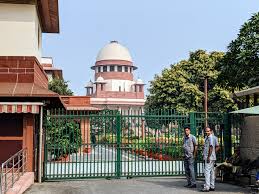
The Supreme Court of India allowed civil appeals filed by Neycer (India) Ltd., ruling that an arbitrator cannot unilaterally widen their jurisdiction beyond the quantified pecuniary limits specified in the original reference documents. The apex court set aside a Calcutta High Court Division Bench order that had restored an expanded Umpire award of ₹11.69 crore. It reinstated the Single Judge’s decision restricting the principal award to the contractually capped sum of ₹2,00,00,000/- (Rupees two crore) after determining that claims exceeding this threshold constituted an error in excess of jurisdiction.
- The Arbitral Reference Threshold: The dispute arose from a 1986 technical collaboration agreement between Neycer and GMB Ceramics Ltd. When differences cropped up regarding project overruns, GMB formally invoked arbitration and specifically defined its claim in its foundational nomination document as a quantified loss of “over Rs. 2 crores”. GMB later amended its claims before the Umpire to aggregate to over ₹17.16 crore.
- Jurisdictional Error vs. Plausible Construction: The Umpire awarded GMB ₹11,69,62,910/-. The Single Judge capped it at ₹2 crore, but the High Court’s Division Bench reversed this, labeling the Umpire’s expansive reading of the reference documents as a “plausible interpretation”. The Supreme Court corrected this view, clarifying that while an arbitrator’s interpretation of a contract is insulated if it is a plausible view, they cannot arrogate jurisdiction to themselves by misconstruing the clear boundaries of a reference.
- Rejection of Speculative Damage Models: The Court criticized the Umpire for awarding ₹2.03 crore under Schedule ‘C’ for brand-building damages based on a hypothetical advertising estimate from 1990. Because the award was passed in 1999, the relevant five-year window had already passed. GMB’s actual audited financial statements showed it spent only around ₹35 lakh on marketing, proving that hypothetical projections cannot override real, available accounting figures.
- Misconstruction of Contractual Obligations: The Court observed that the Umpire wrongly treated the advisory collaboration as a turnkey joint venture guarantee. Contractual phrases like “shall endeavour” indicate an obligation to make earnest efforts rather than absolute underwriting of open-ended business profits or compound debt interest when the plant faced independent labor disputes.
- Final Resolution: Noting that this corporate litigation has gridlocked for nearly 40 years, the Supreme Court modified the award back to the principal limit of ₹2,00,00,000/-. Since Neycer had already deposited ₹4,00,00,000/- (₹2 crore principal and ₹2 crore interest) which GMB withdrew in 2019, the Court directed this payment to be adjusted as full and final satisfaction of the long-standing dispute.
2026 INSC 1251
Neycer (India) Ltd. v. GMB Ceramics Ltd. (D.O.J. 18.11.2026)
Loading Viewer...