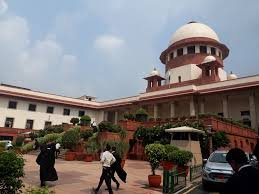

Arbitrary Remission Rules and Victim Rights in Murder Case

The Supreme Court of India quashed the premature release of a life convict—a former MLA convicted for instigating the 1994 murder of an IAS officer serving as District Collector on duty—and struck down Bihar’s April 10, 2023 notification that selectively removed the remission bar for murdering a public servant on duty. Holding the selective amendment manifestly arbitrary under Article 14 and the release procedurally flawed, the Court ordered the convict to surrender within one month and recognized a traceable victim’s procedural right to submit a representation before remission decisions are made.

  • Background & Impugned Actions: The first petitioner’s husband (an IAS officer and District Collector) was fatally shot on December 5, 1994, following exhortation by the fourth respondent, whose life sentence (commuted from death by the High Court and affirmed by the Supreme Court) carried a statutory disqualification from premature release under Rule 481(i)(a) of the Bihar Prison Manual. The widow challenged Bihar’s April 10, 2023 notification deleting “or for murder of a public servant on duty” from Rule 481(i)(a) and the April 24, 2023 order granting premature release to the fourth respondent.
  • Victim’s Procedural Right in Remission: While a victim does not have a veto over remission, a traceable and identifiable victim or legal representative must, wherever practicable, receive notice and a reasonable opportunity to submit a representation so their safety concerns and the crime’s ongoing impact can be considered alongside other relevant factors.
  • Procedural & Statutory Flaws: The fourth respondent’s 2021 remission plea was not maintainable when filed under the unamended bar, and relying on an October 2021 Sessions Judge opinion without a fresh, reasoned contemporaneous opinion under Section 432(2) CrPC and Rule 476 vitiated the rapid April 2023 release process. Non-disclosure of three 15-day parole spells and unresolved age discrepancies further undermined the fairness and bona fides of the process.
  • Unconstitutionality Under Article 14: Departing from a consistent policy since 2002 without empirical backing, correctional rationale, or support from the Model Prison Manual—while retaining other grave murder exclusions—amounted to selective, manifestly arbitrary action violating Article 14.
  • Directions & Balance Under Article 21: The Court set aside the April 10, 2023 notification to the extent of the challenged deletion, quashed the April 24, 2023 release order, directed the fourth respondent to surrender within one month (with no prior revision of Rule 481), and allowed fresh reconsideration in accordance with law after affording the first petitioner a chance to represent—stressing that Article 21 balances reformation with the victim family’s right to live free from fear.

2026 INSC 1281

Telugu Umadevi Krishnaiah & Anr. v. The State of Bihar & Ors. (D.O.J. 26.11.2026)

Loading Viewer...

Next Story

Deemed Licence Tenure Under Electricity Act 2003 Examined

The Supreme Court of India partly allowed the civil appeals, set aside APTEL’s impugned judgment, and directed as an interim measure that Noida Power Company Limited’s (NPCL) licence continue until June 9, 2029, while impleading the Union of India and listing the appeals for further hearing on December 14, 2026. Disagreeing with APTEL’s view that a deemed licensee automatically gets a fresh 25-year term from the 2003 Act’s commencement irrespective of original licence tenure, the Court clarified principles on construing parent statutes alongside subordinate legislation (including Rules 4A–4C inserted in 2023).

  • Factual & Procedural Backdrop: NPCL received a 30-year distribution licence on August 30, 1993 under the Electricity Act, 1910 (due to expire August 30, 2023), while the Electricity Act, 2003 took effect on June 10, 2003; UPERC approved NPCL’s multi-year business plan only up to August 30, 2023 and invited Expressions of Interest on June 8, 2022, which APTEL stayed and later modified on August 23, 2022 to grant a 1-year transition plus 25 years from June 10, 2003 (until June 9, 2029).
  • Statutory Scheme & Competition: Under Part IV (Sections 14–16 and Section 15(8)) of the 2003 Act, a 25-year licence period promotes healthy competition and performance assessment rather than perpetual monopoly or automatic fresh 25-year terms for deemed licensees upon original expiry.
  • Subordinate Legislation vs. Parent Act: Reviewing Indian and UK precedents (including Hanlon, K. Steel, Pali Devi, and Jeevan Chandrabhan), the Court reiterated that authoritative statutory interpretation rests with courts, and subordinate legislation—rooted in executive understanding—cannot control or override the parent Act or pre-empt judicial scrutiny of whether delegated rules are ultra vires.
  • Interim Order & Impleadment: Because the Electricity (Amendment) Rules, 2023 (Rules 4A–4C) took effect on June 30, 2023 before the original licence’s expiry and were not directly challenged with the Union heard, the Court allowed NPCL’s licence to continue until June 9, 2029 as an interim measure, impleaded the Union of India through the Ministry of Power, directed service on the Central Agency Section and Solicitor General, and listed the appeals for December 14, 2026.

2026 INSC 1286

The State of Uttar Pradesh v. Noida Power Company Limited & Anr. (with connected appeals) (D.O.J. 27.11.2026)

Loading Viewer...

Next Story

Incomplete Circumstantial Chain Leads to Acquittal Affirmation

The Supreme Court of India dismissed the State of Punjab’s appeals and affirmed the High Court’s acquittal of the accused respondents in a murder and theft case under Sections 302 and 382 of the Indian Penal Code, holding that the prosecution’s purely circumstantial case suffered from missing links and failed to establish guilt beyond doubt. Finding no reason to interfere with the well-reasoned acquittal, the Court ruled that the alleged circumstances neither inspired confidence nor pointed exclusively to the respondents’ guilt.

  • Background & Trial Conviction: On January 16, 2009, informant Subhash Chander found his wife Kamlesh Rani murdered at home with her gold ornaments and mobile phone missing; following supplementary statements, raids, and recoveries, the Sessions Court convicted four accused under Sections 302 and 382 IPC and sentenced them to life imprisonment and ten years’ rigorous imprisonment respectively, which the High Court set aside on November 29, 2016
  • Overheard Discussion & Last-Seen Claims: The Court found the informant’s claim of overhearing the accused discuss the crime in a hotel hall nearly three months later without being noticed highly improbable, and noted weaknesses in the father’s testimony regarding seeing four persons near the house on the incident date and identifying them later in police custody with no others present
  • Mobile Phone & Recovery Infirmities: Evidence regarding sale of the deceased’s mobile phone lacked supporting records and proper identification parade, while recoveries of a datar (not sent for forensic examination and lacking blood stains) and gold ornaments without independent witnesses or uncorroborated trunk production were insufficient to sustain conviction
  • Circumstantial Evidence Standard: Applying settled principles on circumstantial evidence and appeals against acquittal (including Ramanand @ Nandlal Bharti v. State of Uttar Pradesh), the Court held that the chain of circumstances was incomplete and contained gaping holes, leaving the High Court’s acquittal intact

2026 INSC 1285

State of Punjab v. Neeraj Rana @ Sonu and Others (D.O.J. 27.11.2026)

Loading Viewer...

Next Story

Strict 120-Day Appeal Cap in Land Acquisition Compensation

The Supreme Court of India allowed the landowners’ appeals, set aside the High Court’s order, and dismissed the beneficiary’s application to condone a 255-day delay, following the October 16, 2026 ruling in Rajasthan Housing Board v. M/s. Hariyali Rural Ventures and others that the 120-day appeal period under Section 74 of the 2013 land acquisition law is rigid and cannot be extended via Section 5 of the Limitation Act. The Court directed the respondent-beneficiary to deposit the compensation amount with all statutory benefits before the reference court or High Court within four weeks from the judgment becoming available, noting that detailed reasons would follow.

  • Precedent Adopted: The Court relied on Rajasthan Housing Board v. M/s. Hariyali Rural Ventures and others (SLP(C) No. 35141 of 2026, decided October 16, 2026), which disagreed with Deputy Commissioner and Special Land Acquisition Officer v. S.V. Global Mill Limited and followed the three-Judge Bench binding ratio of Hukumdev Narain Yadav v. Lal Narain Mishra on Section 29(2) of the Limitation Act
  • 120-Day Statutory Cap: Under Section 74(1) of the 2013 Act and its proviso, the 60-day appeal window plus a maximum further 60-day condonable period forms a rigid, inflexible 120-day outer limit that excludes Section 5 of the Limitation Act by necessary implication and cannot be relaxed even for a single day’s delay or under Article 142
  • Prejudice & Legislative Intent: Applying Section 5 of the Limitation Act to expand time-barred appeals under Section 74 would cause reverse prejudice to landowners by letting acquiring bodies seek condonation of inordinate delays, and courts cannot supply omissions or alter clear statutory limits
  • Relief & Deposit Direction: Setting aside the High Court’s impugned order and dismissing the beneficiary’s 255-day delay condonation application, the Court ordered the beneficiary to deposit compensation with all statutory benefits within four weeks from availability of the judgment so the appellants can seek withdrawal according to law, with detailed reasons to follow

2026 INSC 1284

Swarup Baburao Sawant & Ors. v. The State of Maharashtra & Ors. (D.O.J. 03.11.2026)

Loading Viewer...

Next Story

Sentence Reduced on Condition of Victim Compensation in Crash

The Supreme Court of India partly allowed an appeal against concurrent convictions for rash and negligent driving causing death and failing to aid/report an accident, upholding the conviction while reducing the substantive jail term under Section 304-A IPC to the roughly three months already served, conditioned on the appellant depositing Rs. 2,00,000 as compensation for the deceased’s legal heirs within six months. Observing that the collision occurred at a busy eight-road junction and that the lorry halted within a short distance, the Court found the “high speed” claim improbable while keeping the underlying conviction intact.

  • Incident & Conviction: On March 9, 2010, in Mysuru City, motorcyclist Nandish died after colliding with a cylinder-laden lorry driven by the appellant, who stopped nearby and fled without providing medical aid or reporting the crash; the trial court convicted him under Sections 279 and 304-A IPC and Section 134(a)(b) read with Section 187 of the Motor Vehicles Act, 1988, and the appellate court and High Court affirmed.
  • Assessment of Speed: Because the crash occurred at a busy junction where eight roads converge and eyewitnesses indicated the lorry stopped within roughly 25–30 feet / about 20 meters, the Court held that driving at a high speed was not probable on the record.
  • Sentence Modification & Condition: Confirming the conviction and noting the appellant had spent around three months in custody and was the sole breadwinner, the Court reduced his Section 304-A IPC imprisonment to the period already undergone, subject to depositing Rs. 2,00,000 in the trial court within six months for disbursement to the deceased’s legal heirs.
  • Default Consequence & Other Offences: If the appellant fails to deposit the Rs. 2,00,000 compensation within six months, the original sentence will stand restored and he must be taken back into custody to serve the remainder, while convictions and sentences for the remaining offences stand maintained and run concurrently.

2026 INSC 1283

Sarvar Pasha v. State of Karnataka & Anr. (D.O.J. 18.11.2026)

Loading Viewer...

Recent Articles